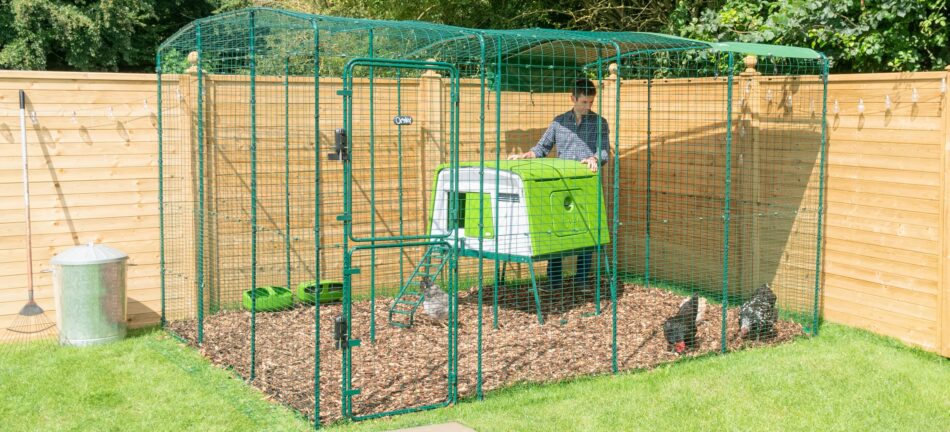
Rats are not usually interested in your chickens. What they’re after is a reliable, easy meal, and a chicken coop that has spilled feed on the run floor, scattered treats, or unattended eggs overnight can look very appealing to a hungry rodent. The good news is that most of what makes a chicken setup attractive to rats is entirely within your control. Keeping your coop and run clean, your feed stored securely, and your flock shut in at night can make your setup far less rewarding for rats to visit.
The short answer: Remove the food source, close off entry points, and secure your flock after dark. Do all three consistently, and rats will look elsewhere.
Why Do Chickens Attract Rats?
Chickens attract rats when their coop and run provide easy access to food, water, shelter, and nesting materials. Rats are opportunistic feeders, and a backyard chicken setup that isn’t actively managed can tick every box they’re looking for. The good news is that the chickens themselves are rarely the draw.
What Rats Are Really After (Spoiler: It’s the Feed, Not the Flock)
Chickens create a consistent food source, particularly when feed or treats are scattered across the run floor or left out overnight. Rats are most active after dark, so anything left in the run by dusk becomes a potential invitation.
Common attractants include:
Spilled pellets or scratch grains on the run floor
Open or loosely covered feed bags stored nearby
Treats not cleared away before nightfall
Standing water in waterers or puddles
Eggs left in nesting boxes overnight
The Risks Rats Pose to Your Chickens and Coop
Rats don’t just steal feed. Left unchecked, they can cause real damage to your setup and create a genuine health risk for your flock.
Contamination: Rats carry diseases including leptospirosis and salmonella, which can be spread through their droppings and urine in feed and water.
Structural damage: They can chew through wooden coops, plastic feed containers, electrical wiring, and stored supplies.
Egg theft: Rats will raid nesting boxes for eggs, especially if they are left overnight.
Risk to young chicks: While adult chickens are rarely at risk, very young chicks can be vulnerable to rat attacks.
A clean, secure setup protects your flock and makes rats far less likely to settle nearby.
How to Stop Rats Eating Chicken Feed
The most effective way to deter rats is to remove their food source. Storing feed securely and reducing mess and waste in the run makes your chickens’ space far less rewarding for rodents to visit. A clean feeding routine is one of the simplest and most impactful changes you can make.
Store Feed in Rat-Proof Containers
Rats can chew through plastic bags and thin plastic buckets with ease. If your feed is stored in anything other than a solid, airtight container, it’s accessible.
Store chicken feed and treats in airtight metal containers with tightly fitting lids.
Keep feed away from the coop where possible, ideally in a locked shed or garage.
Clean up any spills immediately, even small ones.
Never leave open feed bags or buckets in sheds, runs, or outdoor storage areas overnight.
Best No-Waste Chicken Feeder for Keeping Rats Away
The feeder you use matters as much as where you store the feed. Chickens are messy eaters and a poorly designed feeder that scatters pellets across the run floor is essentially laying out a buffet for any rat in the area.
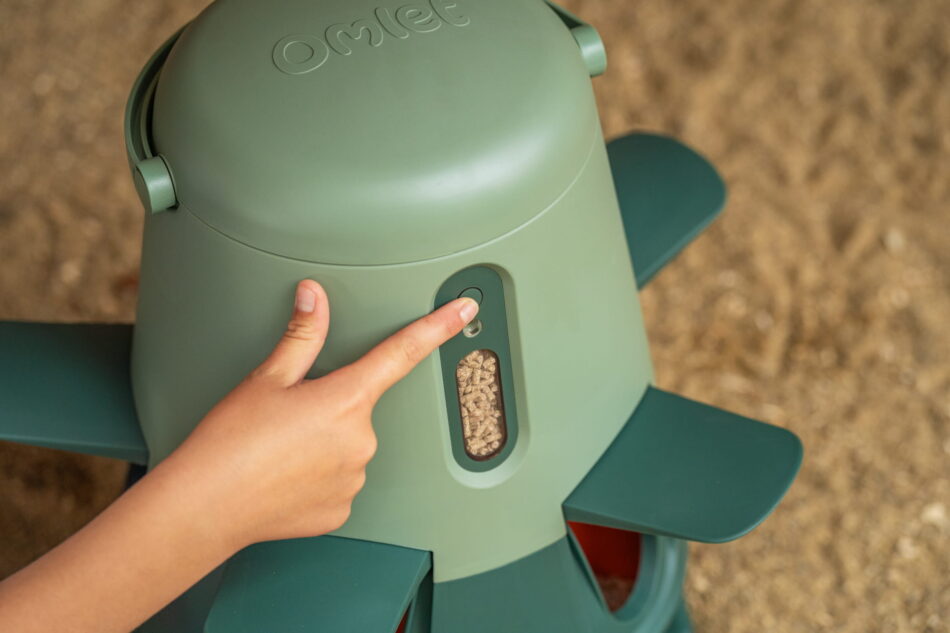
Choose a feeder that’s built to stop mess. The Omlet No Waste Chicken Feeder was designed specifically to stop feed pellets spilling onto the ground, which keeps the run cleaner and removes one of the biggest rat attractants. Raising your feeder to a comfortable height for your chickens also makes it harder for rodents to access. Hanging the feeder takes this a step further.
It’s also important to bring your feeder in every single night to remove the temptation for nearby rats. But this also means remembering to put the feeder back into the run again in the morning for your chickens.
How an Automatic Chicken Feeder Helps Deter Rats at Night
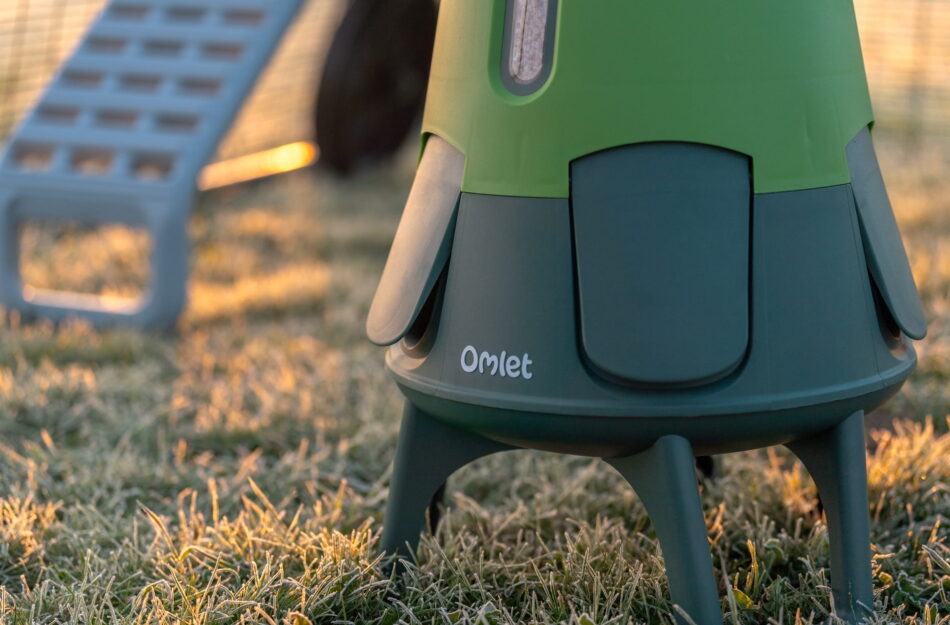
An automated feeder removes the need to remember to bring the feeder in at night and put it back out again in the morning. The Omlet Smart Chicken Feeder has the same no-spill design that keeps mess off the run floor, but it also automatically closes access to feed at night, when rats are most active, and opens again in the morning. You can connect it to your phone and receive notifications when it opens, closes, runs low on feed, or needs a battery change.
The result: your chickens have access to fresh feed all day, and rats have no access at all after dark, all without you having to lift a finger.
How to Handle Treats Without Attracting Rodents
Treats are a common source of mess in the run, and leftover corn or on the floor overnight are exactly the kind of easy meal rats are looking for.
Offer only as many treats as your chickens can finish before dusk.
Use a slow-release treat dispenser like the Omlet Peck Toy, which releases a small amount of corn at a time as your chickens interact with it, keeping excess off the ground.
Hang treats in a Caddi Chicken Treat Holder to keep food off the floor and easy to remove at the end of the day.
Clear away any leftover treats before dusk, every day.
How to Rat-Proof Your Chicken Coop and Run
Rat-proofing is about closing off entry points, removing hiding places, and keeping eggs and feed out of reach. Rats can squeeze through surprisingly small gaps, and they’re persistent diggers, so the physical setup of your coop and run matters a great deal. Regular checks around the structure can stop a small problem from becoming a much larger one.
Use Hardware Cloth, Not Chicken Wire
This is one of the most important upgrades you can make. Chicken wire is designed to keep chickens in, not to keep pests and predators out. Rats can squeeze through the larger gaps, and they can chew through the thinner wire over time.
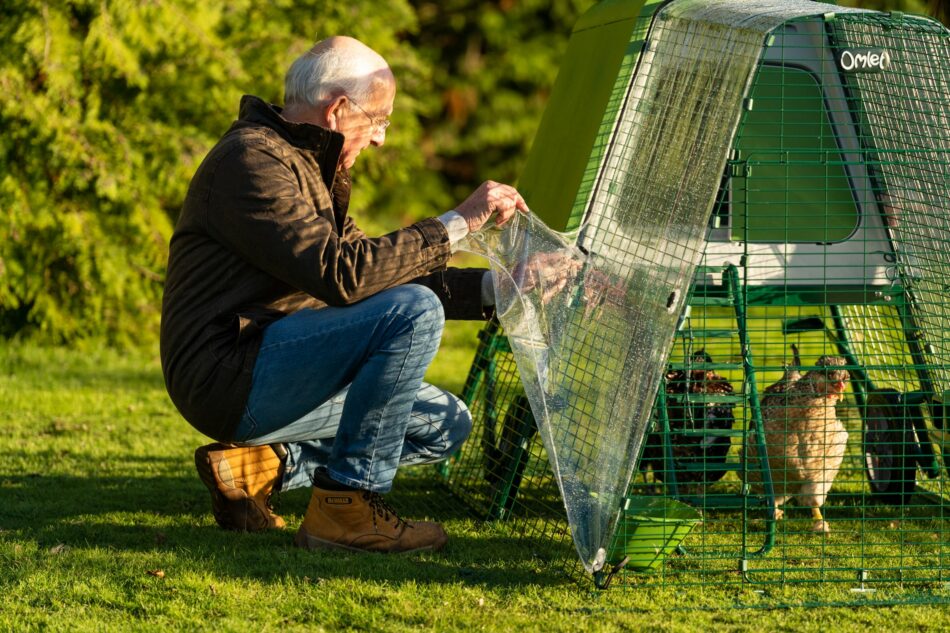
To stop rats digging under the run, bury hardware cloth several inches below ground or extend it outward from the run base as an anti-tunnelling skirt.
Collect Eggs Daily to Remove the Temptation
Fresh eggs are a significant draw for rats, especially when they’re left in nesting boxes overnight. A consistent egg-collection routine is one of the easiest ways to reduce rat interest in your coop.
Collect eggs every day, ideally in the morning and again in the afternoon if your hens are laying well.
Check nesting areas for hidden or broken eggs, which can be just as attractive to rodents.
Keep nesting boxes clean and replace soiled bedding regularly.
An Eglu Chicken Coop is designed with easy egg access and coop cleaning in mind, making daily egg collection and spot cleans quick and straightforward.
Natural and Physical Deterrents That Actually Work
Beyond the structure itself, the environment around your coop can either invite or discourage rats. A tidy, open space with no obvious hiding spots is far less appealing than a cluttered, overgrown one.
Keep grass trimmed short around the coop and run.
Remove piles of wood, leaves, or garden clutter where rats could nest or shelter.
Use motion-activated lights around the coop area to make night-time visits less comfortable for rodents.
Seal any holes in nearby sheds, storage areas, or fencing before rats can establish a nest.
Keep outdoor cat food, bird seed, compost bins, and rubbish secured well away from the chicken area.
One thing to avoid: rodent poisons and snap traps placed in or around the run. These pose a real risk to your chickens, other pets, and children, and are not a sustainable solution when the underlying attractants are still present.
The Easiest Way to Keep Rats Out at Night
Night-time is when rats are most active and most likely to investigate your chicken setup. Securing your flock inside the coop after dark and making sure their feed is inaccessible are two of the most effective things you can do, and when combined, they cover the two biggest reasons rats visit in the first place.
How an Automatic Coop Door Shuts Rats Out While Chickens Sleep
A coop door that’s left open after dark is an open invitation. Rats can slip inside to raid nesting boxes for eggs, access any remaining feed, or simply explore the warmest, driest shelter available.
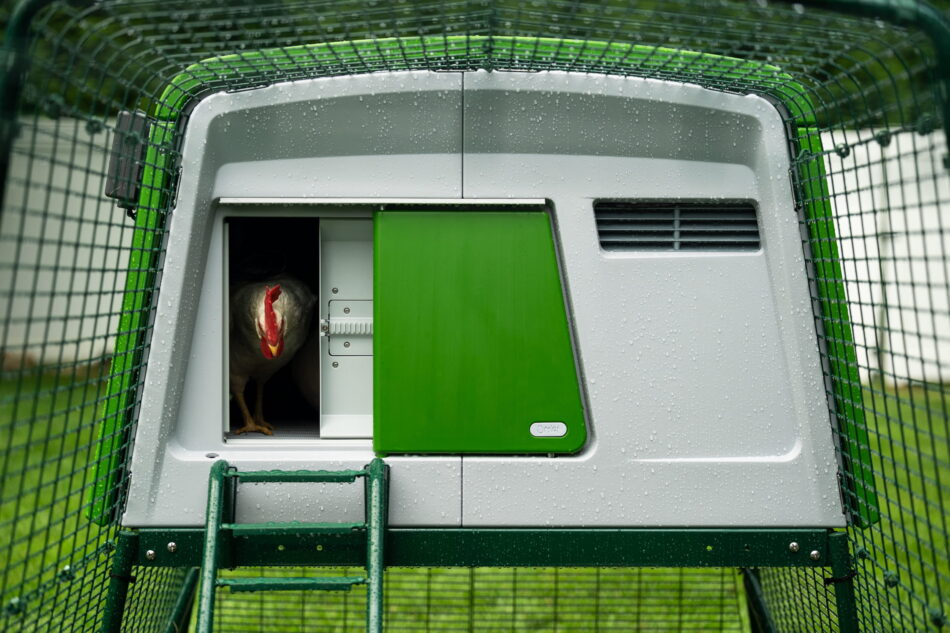
An Automatic Chicken Coop Door closes your chickens safely inside at a time you choose, every night, even when you’re away from home. You can set it by timer or light sensor, and Omlet’s smart door connects to your phone so you can get notifications when the door has opened and closed.
Pairing an automatic door with a smart feeder that closes overnight gives rats fewer reasons to visit and fewer ways to get close to your chickens. It’s the combination that makes the biggest difference to preventing rats, and makes life easier for you.
Key Takeaways: How to Keep Rats Away from Your Chicken Coop
Rats are attracted by easy access to feed, treats, water, and eggs, not by your chickens themselves.
Store feed in airtight, rat-proof metal containers and clean up spills as soon as you spot them.
Get 10% off everything (excluding run covers) for a limited time only in our September Flash Sale!
Whether you’re starting out in chicken keeping, or want to treat your girls to a fresh, new coop, you can save 10% on all Eglus this weekend in our Flash Sale.
Keep your pets safe during outdoor play time with our Walk In Runs, or provide a cosy den for your cats and dogs to cuddle up inside this autumn with the Fido and Maya range of pet furniture.
This 10% off promotion is only valid from 27/09/19 – midnight on 30/09/19. 10% off requires no promo code. This offer is available on all products, excluding Eglu run covers. Subject to availability. Omlet ltd. reserves the right to withdraw the offer at any point. Offer cannot be used on existing discounts or in conjunction with any other offer.
When your cat has access to the outdoors they’ll usually manage to get plenty of exercise by themselves. If you decide to keep them indoors though, you’ll likely need to encourage your cat to exercise. Ensuring your cat is getting enough exercise, in combination with a complete and balanced diet, is vital for their health and happiness. A cat won’t exercise as readily as a dog, but there are a few strategies that will help you keep your cat active and mobile.
The great outdoors
Our product designers wondered how they could create an outdoor exercise space for indoor cats that didn’t compromise on safety or adventure.The result? The Omlet Catio. The perfect way to get your cat moving, Omlet’s Catio provides your cat with all the benefits of the great outdoors, without compromising on safety. The customizable design means that this outdoor cat enclosure works perfectly for all sizes of gardens and cats, and is purpose-built for the addition of a Freestyle Cat Tree – the ultimate cat gym every indoor cat needs, bound to get your cat off the couch and jumping, scratching and climbing all year round.
Is a scratcher the solution?
Cat scratching posts are an essential part of maintaining feline fitness. Omlet’s Switch Cat Scratching Post not only supports a cat’s natural desire to claw with its biodegradable sisal sleeve but what really makes this the coolest scratcher to ever exist are the 1,200 irresistible light modes. Yes, that’s right – we’ve really created a light-up cat scratcher.
With inbuilt, customizable lights, the Switch is a brain-training, full-body workout. We know that getting a cat to use a scratching post isn’t always easy but we also know that cats are fascinated by fast-moving, bright lights. The Switch engages their natural hunting instinct, with irresistible LED prey to stalk, chase and pounce on all day.
It’s also the sustainable choice. Choosing the Switch can save up to 49 KG of CO2 emissions over a cat’s lifespan, compared with a like-for-like scratcher. The bamboo base lasts indefinitely – you only need to replace the 100% biodegradable sisal sleeves every 6 months. The Switch is the scratcher with serious staying power.
Cat wheels – fad or fitness phenomenon?
Exercise wheels are a relatively new cat product which provides both mental and physical stimulation. The wheels are entirely cat-driven, so by using it, your cat will train their muscles and burn calories. It often requires training for your cat to build up confidence and learn how to use the indoor cat wheel. High-energy breeds like Bengals and Sphynx tend to learn the easiest.
Is it ever okay to play with your food?
In their natural environment, cats have to hunt for their food and eat about twelve times a day, whereas cat owners will simply put food into a bowl and walk away. You can add some excitement and activity to feeding time by using a food ball. This is a ball the size of a tennis ball, in which you can put dried cat food. As the cat pushes and bats the ball the food will gradually fall out.
Time for play
An indoor cat will need plenty of stimulation and play to prevent them from becoming bored. Cats play to mimic their natural hunting behaviour, although not all cats have the same levels of motivation. Find out what cat toys your feline friend likes and dislikes by trying toys with different textures, shapes, sizes, noises and scents. Most cats enjoy interacting with their owner and playtime is a great way to develop the bond between you and your pet.
Some cats go wild for laser toys. The intensity and length of the sessions should depend on the cat’s age and physical condition. Be sure to never shine laser pointers directly into your cat’s eyes and at the end of the playtime, gradually slow down the beam until it comes to rest on a soft toy the cat can catch to avoid frustration.
Crazy for catnip
Nepeta Cataria is a plant that is commonly known as catnip or catmint. The response seems to be a kind of euphoria, similar to how humans respond to hallucinogenic drugs, although catnip is neither harmful nor addictive for felines. You can either buy catnip toys, make classic cat toys more interesting by filling them with catnip, or use a catnip spray. Usually, the effects of catnip last anywhere from 10 minutes to an hour, depending on the cat. Find out more about the remarkable effects catnip has in our previous Why do cats love catnip? blog.
Omlet and your cat’s exercise
We design innovative products like the Omlet Catio, Freestyle Cat Tree and Switch Cat Scratcher to support your cat’s innate natural behaviour. At Omlet, we are always asking how we can use design and tech to meet your cats’ natural needs, both physical and mental. Because the happier they are, the happier we are.
Have you ever wondered how your cat communicates with other cats? Do they speak in meows like they do with humans or do they have a special ‘cat only’ language?
Cat communication has evolved a lot over time. In the wild, the cat meow is a much lower, lingering sound than what we are used to. Fascinatingly, the beloved higher-frequency meows we hear are what cats learned through domestication to be more appealing and get what they want. As a result, domesticated cat’s meows are reserved mainly for us humans. When it comes to communicating with other felines, cats have several different ways they choose to ‘talk’. Let’s explore the many ways your cat communicates with other cats…
Talking cat-to-cat
Cats use the vocalization of meows or purrs to tell other cats (or you) what they want. With different pitches and intonations, they’re able to ‘speak’ their different physical or emotional needs. Here are a few examples of the types of sounds cats make and what they mean:
Trilling-chirruping sounds – Cats will make this cat-specific sound when watching or stalking potential prey.
Pleading, drawn-out “mee-owww” – This delightful sound is mostly reserved for us humans – it’s their way of saying “pay attention to me and give me a snuggle!”.
Low growl: When a cat wants to be left alone, they will communicate with this low-level warning to tell another cat “back off” or “leave me alone”.
Wailing hiss: You’ll know your cat is in distress or about to launch an attack when you hear the anxiety-ridden hiss sound.
A tale of cat tails
While using their voice is the way we most associate a cat’s ability to communicate, for everyday communication, cats actually prefer to use their body. More specifically, their tail. A cat’s tail acts as a flag waved on a stick. You can tell how they’re feeling and what they’re communicating when you better understand what each tail position means.
Let’s talk cat tails! If you see your cat’s tail upright in the air, this is usually a sign they’re feeling chilled out and friendly. And if they start gently swinging the upright tail back and forth, you can rest assured that your feline friend is super relaxed. They may even roll over on their snuggly cat bed for a belly rub and a snuggle.
On the other hand, if you notice your cat’s tail lashing back and forth in a quick motion this most likely means they are stalking something with intent. And if they start swishing their tail furiously this is your clue to check their surroundings as it can indicate the early stages of anger. Best to make sure you have a secluded sanctuary, like the Maya Cat House designed by Omlet for your cat to escape anytime they feel too much anxiety.
The eyes have it
It’s often said that in a cat’s eyes, all things belong to them. But did you know cats can actually communicate their mood with their eyes? Here are some common cat eyes to keep your eye on so you can better understand what they are saying:
A hard stare: If you catch your cat in a stare off this usually means they’re locked in on a danger or prey. Their focused, unblinking eyes are a sign of dominance and usually a warning sign to other cats, or even cat toys, to be aware.
A slow blink: Just like a wink is a sign of affection from your loved one, a slow blink from a cat means the same. It’s as if they are giving you kitty kisses with their eyes!
Eyes wide open: Wide, alert cat eyes may seem to indicate something is wrong, but in actuality, this is a sign of trust. Often the big eyes are followed by a head butt to really drive home the trust factor, but all the same, it means your cat is in good company.
Lazy squint: There’s really nothing better than a lazy eye cat squint. You know, the half-blink, half-asleep look you get when your kitty is getting cozy on their cat blanket. Next time you eye your cat giving you this look rest assured they are content, calm and happy.
Smelly messages
When it comes to cats, the nose knows. Scents are vitally important to cats and another way they communicate. In fact, cats use their scent glands to leave pheromone signals across their territory, both in the home and outside.
By using the scent glands on their cheeks, cats will rub your leg, the couch or even a fellow feline to literally spread their love. This is a form of affection, you could argue, but its main aim is to spread the pheromone messages. Cats also have scent glands where the tail joins the body, however, this is a less appealing region to be rubbed by!
Tom cats, or male domesticated cats, will often spray urine on things to ‘mark their territory’. Thankfully, this is typically an outdoor experience, however, it could become an inside issue if a strange cat has ventured into the building. Neutering usually brings an end to this macho, territorial habit.
Omlet can speak cat
Much of this communication behavior stems from the fact that cats are not pack animals. And so communicating with others is not a regular occurrence. At Omlet, we speak cat and we know all too well how much they need their personal space, only inviting others into it – feline or human – when they’re in the mood.
That’s why it’s important that you have a secluded spot for your cat to retreat to whenever they want so they can feel their best at all times. TheFreestyle Indoor cat tree designed by Omlet is a perfect cat sanctuary as it allows your cat the ability to escape up high away from humans or other pets when they need that coveted alone time. Learn to recognize the feline’s vocal and body language, and you’ll soon be able to ‘speak cat’ yourself!
Many people with indoor rabbits would like to let them roam free in the house, giving them more space and including them in daily family life, but worry that they will have to spend their time picking up droppings and wiping up wee. They might however not realise that rabbits, like cats, can be trained to use a litterbox.
Preparations
If you haven’t already done so, you will need to spay or neuter your pet, as an unspayed or unneutered rabbit will be almost impossible to litter train. You will also need to keep the rabbit in a confined space until they’re fully grown. Unlike with dogs and cats, it’s much easier to train older rabbits, as their attention span and learning abilities are very limited when as babies or very young.
Litter training a rabbit can take some time, and accidents will most certainly happen, so make sure you have enough patience to get through the process with your pet. Rabbits, like most animals, will not respond well to any type of punishment, so never tell your rabbit off when he or she has done something wrong. This will only make them forget what they have learned, and they will be more reluctant to try again.
Choose The Right Place
While the rabbit is learning, you will need to keep him or her in a confined space in the house. Bathrooms or utility rooms are good places, but you can also set up a playpen, ideally in a room that is not carpeted.
You will most likely be needing several litter boxes further along in the training process, but start with one. If you notice that the rabbit keeps going into a different corner to wee or poo, move the box to their preferred place.
The Litter Box
Rabbits want space to stretch out in the box, so make sure you get one that is big enough. You will be able to find boxes specifically designed for rabbits, but the best option is normally a simple medium sized tray-type cat litter box. Just make sure the rabbit can easily hop into it.
Prep the box with a layer of absorbent litter. Carefresh is a perfect alternative as it soaks up any unwanted odeurs, but you can also use shredded paper or wood based solutions. Don’t use anything that will be dangerous for the rabbit to ingest, as they will nibble on the bedding. Make sure to also stay away from softwoods like pine or cedar, as well as clay-based or clumping litter, as they can be harmful to your bunny.
Put a good layer of good quality hay on top of the bedding, and add some of the droppings and urine-soaked bedding. This will guide the rabbit to the right spot.
Try It Out With Your Bunny
Let the rabbit into the training room or area, and stay with him or her. When you see them leave droppings or urinate, immediately lift them up and put both the bunny and the droppings in the tray. Talk softly and pet him or her. This should after a while hopefully get the message across that the litter box is the right place to go. Spend as much time as possible doing this over a few days. When you need to leave, put the rabbit back in the hutch or smaller enclosure. Repeat daily until you can trust them to know where to go.
When you think you rabbit is ready to move on you can gradually expand the area where the rabbit is kept. Don’t overwhelm them with the whole house at once, as that will only mean that the rabbit will forget where the litter box is, and all that hard training will go to waste.
Notice where accidents tend to happen, and put out extra litter boxes there. This might mean you have to move the rabbits cage or rearrange some furniture, but once you have got it right it will be worth it.
It’s important to note that very few rabbits are 100% reliable with their litter box. Accidents will probably keep occurring throughout the rabbit’s life, and that doesn’t mean that the training has failed. It is also normal for the rabbit to leave a few droppings right next to the box or sometimes urinate on, or over, the edge of the tray. Put a mat or some paper under the box to make it easy to clean.
Pet ownership isn’t just for the young. In fact, people from all walks of life can enjoy the companionship and love that animals have to offer. There are a few extra considerations to weigh when choosing the best pets for older people – but with some planning and preparation, pets can help older owners feel young at heart.
Why pets are good for seniors
It’s a well-studied and widely-known fact that pets can be therapeutic. Many long-term healthcare facilities employ the use of dogs, cats, and other tame animals in programs that inspire, uplift, and encourage their occupants. Pets offer love and affection with no strings attached, and no questions asked – giving many people a boost in mental health, an air of peace, and a feeling of importance.
For seniors, pets can bring companionship, a sense of purpose, and even improve health conditions or concerns. But great thought should be put into selecting the right pet, planning for their future, and knowing when and from whom to solicit help in caring for them when the time comes.
The best pets for older people
Whether you’re looking for a pet to enjoy during retirement, or thinking about gifting a loved one with an animal companion, it’s important to keep in mind:
The physical ability of the owner
Time and space requirements of the pet
Average lifespan of the pet
Pet care shouldn’t burden the owner, nor should it be compromised when owners are no longer able to perform the tasks necessary for their health and wellbeing. It’s a good idea to have friends, family members, or other resources in place if an elderly owner should need assistance with their pet. Additionally, pets that might be perfect for elderly individuals can come with a few caveats to consider.
Cats
Arguably one of the easiest companions, cats are at the top of the list when deciding on a pet for older people. Some breeds of cats are more easygoing than others, but in general, most adult cats make excellent companions for those getting on in years.
Cats don’t require much space – they’re happy to share a home with their owners. Having a natural desire to bury their eliminations, litter box training is quick and easy, and the vast majority of indoor cats have mastered this skill by the time they’re a few months old.
Felines are also known for being very self-sufficient. They can be free-fed, meaning their food can be left out and refilled as needed. The majority of a cat’s day is spent sleeping, with the average cat snoozing up to 18 hours or more each day. Older cats can be readily found at shelters, rescue organizations, or adoption events – most of which will already be spayed or neutered and vaccinated.
Feline factors:
Kittens have lots of energy, and can easily (though usually, accidentally) break the skin of older people with their teeth and claws
Cats have long lifespans, averaging 12-18 years – though some can live up to 20 years and beyond
Litter boxes will need to be cleaned regularly
Vaccines are necessary for cats, so vet visits will be inevitable
Dogs
Dogs are a close second behind cats when considering ease of care and companionship. Their loyalty and devotion is hard to match, and their care is easy and straightforward. Dog breeds are diverse and numerous, giving dog owners many choices when selecting their companion.
Older dogs are typically “set in their ways”, and are usually housebroken, spayed or neutered, and fully vaccinated. Younger dogs can be a good choice for older people, so long as they have learned the basics of housetraining and obedience, and have finished teething – usually by 8 months of age.
For owners with specific health concerns, service dogs might not only be wonderful companions, but life-saving. Many dogs can be trained to alert owners to events like high blood pressure episodes, impending seizures or fainting spells, or low blood sugar levels. So, if you’re looking for a pet to accompany an ageing loved one, a dog trained to alert them to medical events can be an excellent option.
Canine considerations:
Puppies require a lot of work to housetrain, and will be busy teething on furniture, shoes, human hands and feet, and anything else they can get their mouth around
Exuberant breeds, young or untrained dogs may jump up and knock older people off balance
Dogs will need to be let out in an enclosed garden or walked on a leash multiple times per day to relieve themselves and exercise
Small dog breeds can live 15-18 years on average
Certain breeds have coats that may require regular grooming
Vaccines are required for dogs, so vet visits are a necessity
Chickens
They may not be a conventional pet, but chickens are great for people who love to spend time outdoors. Starting a flock during retirement is an excellent way to enjoy fresh air and keep your mind and body active. And, thanks to recent recognition, hens are now allowed in many urban areas.
Chickens do require their own companions, so you’ll need to keep at least 2-3 hens at a time. Surprisingly, chickens don’t require an excessive amount of space, with most urban gardens having plenty of room. And, hens are very self-sufficient, able to free feed and forage for their meals.
Flock factors:
Chicken-keeping can be physically demanding
Hens are limited to the outdoors
These birds of a feather must flock together in a group of at least 2-3 hens
Chickens have a relatively short lifespan, averaging 4-6 years
Eggs will need to be collected regularly
Small birds
Small birds can be appealing companions for senior owners. Their lifespans aren’t as long as parrots and other larger birds, and their care is more simple. Choices like parakeets, canaries, and finches are good options for older adults.
These birds are easy to care for, beautiful to look at, and provide songs (and potentially even words in the case of parakeets) as feedback to their caretakers. Elevated bird cages make it easy to view the inhabitants, and are easy to clean.
Parakeet parameters:
Small birds may be more difficult to hand-tame, and may fly off on a house-wide excursion
Parakeets may learn to mimic sounds they commonly hear, such as appliance beeps, doorbells, etc.
Rabbits and guinea pigs
Small animals like rabbits and guinea pigs are other pets for older people. They’re fairly self-sufficient, thriving on a free-fed diet of pellets and hay, and are entertaining to watch. Easy-to-clean outdoor rabbit and guinea pig hutches help reduce indoor odours and give an opportunity for their owners to spend more time outside. Rabbit and guinea pig life spans are similar, with 8 years and 6-7 years being their averages respectively.
Rabbits and guinea pigs are soft, full of character, and are very animated animals. They’re a joy to watch, and can interact with their owners much like a dog or a cat would. Rabbits can be kept individually so long as they have plenty of interaction with their owners, but guinea pigs are highly social and always do better in bonded pairs.
Small pet special considerations:
Rabbits and guinea pigs may be difficult for older people to pick up and handle
Rabbits in particular have sharp nails and powerful legs, which may accidentally injure those with thin skin or who bruise easily
Guinea pigs must be kept in pairs, and can be very vocal
Pets that aren’t perfect for older people
For many ageing people, having pets is about companionship. A bond between a human and animal is a powerful thing, but like all relationships, sometimes there are not-so-great matches made. For example, an older person who has limited mobility or flexibility should probably not embark on a potty-training journey with a rambunctious puppy. Or, an elderly person seeking a warm lap-napper would benefit more from an older, calm cat than an active kitten.
Other pets that aren’t the most companionable for older people include:
Reptiles
Insects
Fish
Rodents
Large birds like parrots
Exotic pets like hedgehogs, sugar gliders, and ferrets
While each pet has something unique to offer to their owners, these animals require specific care and attention that is probably not suitable for someone seeking companionship over novelty.
Enjoying pets with Omlet
No matter what phase of life you’re in, our pet products bring joy into the lives of pets and their people. From luxury dog beds that add character to your home, to litter box furniturethat is both discrete and functional, your pets can bring both companionship and charm to your home. Our designs deepen the bond between animals and humans, making their connection lasting and wondrous.
Have you ever wondered if your dog is older than you in human years? If you’re like most dog owners, you’ve probably come across the rule that one year for your dog equals seven human years. But this rule is actually far from accurate and the math is not that simple.
The notion that one dog year is equivalent to seven human years has been regurgitated more than chew toys. But calculating a dog’s age in human years is dependent on so many other factors. What breed is your dog? Is your pup big or small? All of these details matter when converting dog years to human years.
So if you want to really find out how old your 4-year-old Shar Pei is in human years, follow along as we debunk the myths and uncover the facts.
Where did the “seven-year rule” come from?
While the exact origins of the 1 to 7-year rule for dogs to humans are not completely known, we do have a few examples dating back to the 1200s on how it came to be. In 1268 a “Judgement Day” calculation was inscribed on the floor at Westminster Abbey stating that humans live to the age of 81 and dogs live to the age of 9. But that’s a 9:1 ratio? Correct. Keep reading.
Then in the 1700s, Georges Buffon, a French Naturalist, created the theory that humans live to 100 and dogs live to 10. Ultimately claiming that the dog-to-human year ratio was 10:1. Ok, but that’s still not 7:1 – how did we get to that conclusion? Stay with us.
It wasn’t until almost a quarter of a century later in the 1950s that the rhetoric concerning the average age of humans changed. The new human lifespan was estimated to be age 70. Ironically, the average lifespan of dogs still maintained to be an average of 10 years. So it was around this time in history that the 7:1 ratio of dog life to human years was created. Veterinarians and pet owners quickly adopted this rule of thumb and so became the “seven-year rule” on calculating dogs’ age in human years.
How do you really calculate dog years into human years?
One fact that researchers, scientists and veterinarians can all agree on is that dogs age considerably more rapidly in their first year of life than at any other time. Especially compared to humans.
The American Veterinary Medical Association (AVMA), which represents more than 100,000 vets, has heavily researched the topic of dog aging and concluded a new standard. They evaluated specific dog breeds and sizes to come up with a sliding scale of the average aging process of dog to human years. Here’s what they concluded:
For all dog breeds and sizes, the first year of their life is equivalent to 15 human years. This explains why one-year-old puppies act a lot like human teenagers!
Based on size alone (large dog vs small dog), the second year of every dog’s life is equivalent to approximately 9 years. So by the time your Dachshund is 2 years old, they’re legally (in human years) able to drive you to work – although we don’t recommend that!
Every year thereafter, dogs can age anywhere from 4-7 human years for every dog year depending on breed and size. This means giant breeds like Newfoundlands could be pushing 40 in human years by the time they turn 4 in dog years.
Do smaller dogs live longer than larger dogs?
In the wild, larger animals like elephants and whales, tend to live longer than their smaller counterparts, like mice. However, in the canine world, this phenomenon is the opposite. While there are exceptions to every rule, it’s widely known that smaller dogs tend to live longer than larger dogs.
But why? Scientists don’t have any definitive answers to explain this reality, but there are some assumptions that try to answer the question. Plain and simple, larger dogs age and grow faster. And as their bodies grow, so, too, do the proteins that make up the molecular structure of their bones and organs. While there’s no concrete evidence, many scientists believe that this faster rate of protein production could be a cause of a shorter lifespan in bigger dogs.
Faster aging in bigger dogs isn’t the only explanation, but there is a tendency for larger dogs to have more health problems as compared to smaller dogs. Developmental disorders in the musculoskeletal and gastrointestinal areas are more prone to be prevalent in bigger dogs and this is linked to their accelerated aging and growth. Think about a Great Dane as an example. At birth, these giants are already 10 times the size of their pint-sized pup counterparts.
How Omlet can support your dog’s healthy lifestyle
Just like humans, the makeup and genetics of dogs are a huge factor in the length of life they live. And while there isn’t anything we can do to course correct their DNA, there are a few things, and many products, that can be utilized to make sure the life your dog lives is a healthy and happy one.
Well-balanced diet: You can never go wrong feeding your dog a healthy and nutrient-rich diet. As humans, we often live by the phrase, “you are what you eat”, and the same is true for dogs. So be sure to give your dog a healthy meal every day. Using an environmentally safe dog bowlwill support your dog’s health regardless of their age.
Move those muscles: Active dogs are healthy dogs and the more they exercise, the healthier they will be. Just be cautious and don’t overdo it as some breeds are more prone to join injuries. Some dog breeds are more prone to joint injuries than others. Moderate walks and games of fetch are always great ways to get your dog physically moving. But be sure to incorporate play with stimulating dog toys as well to get those doggy minds happy and healthy, too.
Comfort is key: What’s the number one thing that helps humans live longer? Sleep. And while there’s no link between sleep and a dog’s aging process, there’s no denying they have their paws on the pulse of slumber. So why not make sure they have the ultimate comfort when snoozing. A supportive and memory foam mattress like Topology, designed by Omlet, is the perfect dog bed for any size pup or breed. Add a super soft dog blanket and your pup will be living their best life..
All dog owners can agree that our pups may not make up our whole lives, but they definitely make our lives whole. Understanding how and why they age is the first step in making sure the time we do have with them is the best for both of us. Whatever the age of your dog, one thing’s for sure – Omlet is here to provide you with all the products you need to give your dog the best life possible.
Moving can be stressful for everyone involved – including your pets. Thankfully, there are a few things you can do to minimise pet stress when moving. From furry to feathered family members, we’ve got solutions to keep your pets’ stress levels at a minimum during this big transition period.
Preparing for the move
Packing your pets’ essentials is an inevitable part of moving – but it’s something that you should try to time just right to help reduce the amount of stress they’ll endure. Try to pack your pets’ items last so that they’ll be first off of the moving truck when you get to your new home. If possible, keep comfort items like dog beds and cat beds available throughout your move.
Small pets like budgies should be kept in their cages for the entire move if at all possible to reduce stress. TheGeo Bird Cage can be transported without being disassembled (aside from removing it from the optional stand).
Outdoor pets like chickens, rabbits, and guinea pigs pose a slightly more challenging endeavour. Chicken coops should be left assembled for as long as possible so that your flock can stick to their routine. Large items like the Omlet Walk in Chicken Run should be moved to your new home and reassembled as soon as possible, leaving your flock to stay in their coop’s attached run, or inside of chicken fencing in the meantime.
Rabbits and guinea pigs can be housed indoors or in small pet playpens temporarily during a move. A guinea pig playpen or rabbit playpen can comfortably house your pets for a day or two while you finish packing their things.
Temporary accommodations
If your move will be local, you may also want to consider leaving your pets with a friend or family member, or boarding them at a facility while you set up their things at your new home. Or, in the case of chickens, you could move your flock to your new home and have a chicken sitter watch them while you continue to pack and move the rest of your belongings.
Take extra care with cats, as they are more likely to experience deeper feelings of stress over moving than other pets. Hiring a cat sitter may be a good option, but only if your cat can remain at your current home until the day you move into your new home. Having someone check on them in a strange new home without you there is a sure way to stress out your cat.
During the move
Some pets enjoy travelling – others would rather be anywhere else, doing absolutely anything else. Thankfully, there are a few ways to help hit the road with your dog, cat, chickens, or small pets:
Introduce the concept of a car ride to your pet well in advance of moving day. For dogs and cats, this could be taking them to the car and feeding them special treats. For chickens, rabbits, and guinea pigs – practice handling them and placing them in their travel containers with lots of treats. These practice sessions should be short and sweet, gradually building up to short car rides.
Never let an animal roam freely in your vehicle. Ideally, all animals should be transported in travel crates, but some dogs especially may be too large for this to be a feasible option. Dog seat belts and harnesses are available, and are an excellent way to keep your pup safely where they should be in your vehicle.
Small pets in crates or cages should be covered as long as they’re able to receive ample ventilation and airflow. Blocking out visual stressors will help your nervous pets travel better.
If the trip is long, take breaks every hour or two to offer your pets water. Don’t attempt to offer food to travelling pets, as this could upset their stomachs. Dogs should be taken outside on a leash at each stop to stretch their legs and relieve themselves.
Welcome them home
Once you’ve finally made the transition to your new home, try to set up your pets’ things right away, and as close to how they were used to seeing them. If your dog’s water was in the kitchen, try to put it in your new kitchen. If your chickens’ coop was under trees before, try to find a shady spot in your new garden. The idea is to make as few changes as possible to your pets’ routine and preferences.
Place indoor pets in a safe room while you unload their things. Make sure your cats, rabbits, or guinea pigs have access to a litter box during this time. Chickens should be placed in their run as soon as possible. Once everyone is settled, try offering a small amount of food and fresh water.
When you’re ready to introduce your pet to the new house or garden, make sure:
All exterior doors and windows are closed to prevent accidental escapes
Any gates or access points to your garden are closed
Dogs and cats have their collars and identification tags on
If your cat is used to going outdoors, prevent them from going outside for the first two weeks of being in your new home. This will firmly establish that this new dwelling is “home”, and help prevent roaming.
Give all pets plenty of time to settle in. Small pets like budgies should fall right back into their usual patterns once their cages are in their permanent locations. Rabbits and guinea pigs may spend more time in their hutches, but as the days go on, they’ll venture out to take in their surroundings. Chickens may not lay eggs for the first few days following a move, which is completely normal under the circumstances.
Making a move with Omlet
Our products make it easy to take a piece of home with you wherever you go. Whether it’s your dog’s favourite blanket or your cat’s preferred bed, your pets can carry a comfort item with them during a move or during a temporary stay with friends. From chicken tractors and mobile rabbit and guinea pig hutches that you can wheel onto a trailer with ease, to take along bird cages, we make moving just a little bit easier so that you can get back to the good life with your pets as quickly and safely as possible.
By clicking "Accept All", you agree to the storing of cookies on your device to enhance site navigation, analyze site usage, and assist in our marketing efforts.
Privacy Preference Centre
When you visit any website, it may store or retrieve information on your browser, mostly in the form of cookies. This information might be about you, your preferences or your device and is mostly used to make the site work as you expect it to. The information does not usually directly identify you, but it can give you a more personalized web experience. Because we respect your right to privacy, you can choose not to allow some types of cookies. Click on the different category headings to find out more and change our default settings. However, blocking some types of cookies may impact your experience of the site and the services we are able to offer.
Manage Consent Preferences
Always Active
These cookies are necessary for the website to function and cannot be switched off in our systems. They are usually only set in response to actions made by you which amount to a request for services, such as setting your privacy preferences, logging in or filling in forms. You can set your browser to block or alert you about these cookies, but some parts of the site will not then work. These cookies do not store any personally identifiable information.
These cookies allow us to count visits and traffic sources so we can measure and improve the performance of our site. They help us to know which pages are the most and least popular and see how visitors move around the site. All information these cookies collect is aggregated and therefore anonymous. If you do not allow these cookies we will not know when you have visited our site, and will not be able to monitor its performance.
These cookies enable the website to provide enhanced functionality and personalisation. They may be set by us or by third party providers whose services we have added to our pages. If you do not allow these cookies then some or all of these services may not function properly.
These cookies may be set through our site by our advertising partners. They may be used by those companies to build a profile of your interests and show you relevant adverts on other sites. They do not store directly personal information, but are based on uniquely identifying your browser and internet device. If you do not allow these cookies, you will experience less targeted advertising.
 Free returns
 180-day guarantee
 10% off your first order