 Free returns
  180-day guarantee
  Sign up to our newsletter
 We ask. We invent: the story behind the Insulated Chicken Drinker.
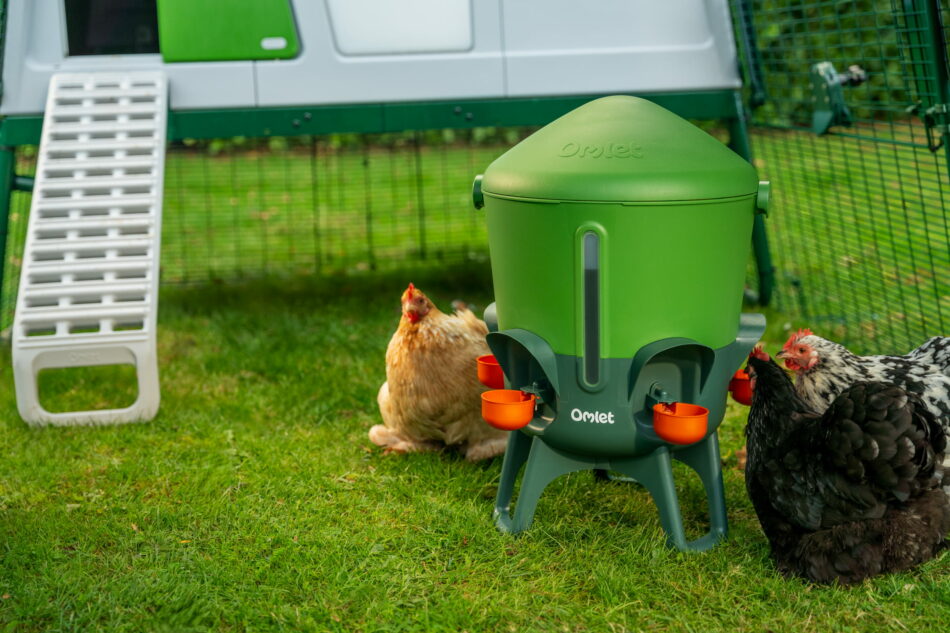
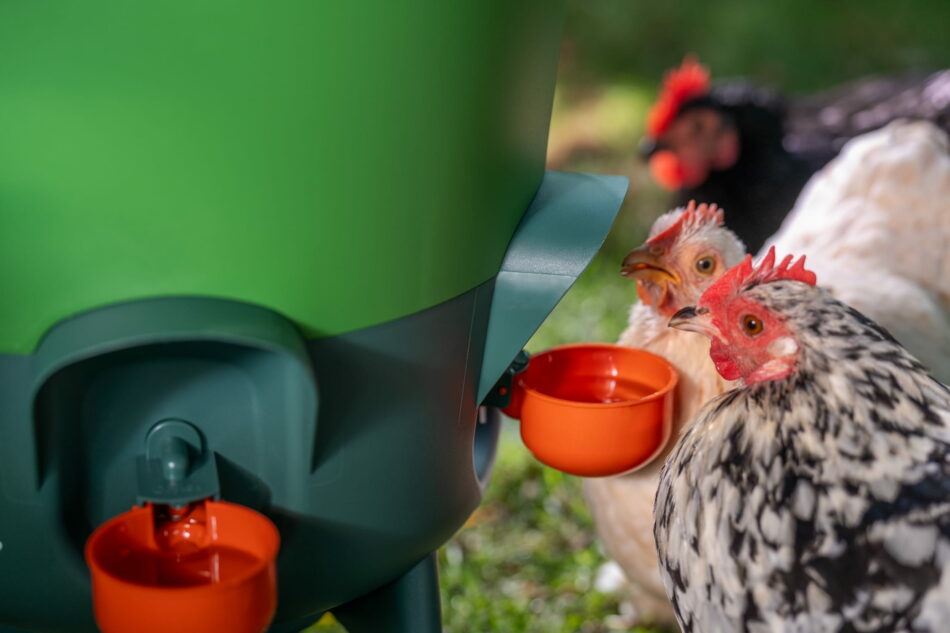
Most chicken keepers know the routine – breaking ice on winter mornings, adding ice cubes on hot summer afternoons. Scrubbing away algae. Refilling water that somehow seems dirty again five minutes later.
When Omlet started speaking to chicken keepers around the world, these frustrations came up again and again. What began as a conversation about frozen water quickly revealed a bigger challenge: keeping water clean, accessible and appealing to chickens all year round.
Over the next two years, that challenge would lead to customer visits across the UK and the US, hundreds of product testers, countless prototypes and some surprisingly extreme temperature tests. Here’s the story of how Product Research Manager, Rebecca and Design Manager, Josh transformed hundreds of conversations with chicken keepers into the Omlet Insulated Drinker.
The why

With Rebecca, Product Research Manager
Every Omlet product starts in the same place: with a question. Not “What should we make next?” But “What are chicken keepers struggling with?”
For the Insulated Drinker, that process began in 2023. Rebecca and the research team visited chicken keepers across the UK and the US, spoke to customers online, gathered feedback through surveys and worked closely with Omlet’s product testing communities.
“We begin by listening carefully to people who know their flocks best. Sometimes a single comment, routine, frustration or little hack can unlock a much bigger insight.” The team visited around 20–30 chicken keepers in person and continued gathering feedback from hundreds more through Omlet’s Curious Collective, surveys and product testing groups.
One topic kept coming up: water.
Not just keeping it available, but keeping it clean, fresh and at the right temperature. At first, the focus was winter. Chicken keepers told the team they worried about water freezing, particularly when they were away from home or relying on someone else to care for their flock. Many didn’t have access to electricity near their coop or run, making heated drinkers impractical. But as the research continued, a second challenge emerged…
“In summer, many chicken keepers struggle to keep water cool, fresh and clean. Some add ice, while others battle algae when drinkers sit in direct sunlight.” What started as a winter problem quickly became a year-round challenge.
What were chicken keepers looking for?
As Rebecca’s team dug deeper, a clear picture began to emerge. Chicken keepers weren’t just looking for a water container. They wanted a solution that would:
- Keep water cleaner for longer
- Help reduce algae growth
- Stay stable on uneven ground
- Be easy to clean and refill
- Support temperature regulation in both summer and winter.
“What became clear was that there wasn’t really a solution that combined cleaner water for longer with support for temperature regulation.“

Expect. Seek. Discover.
At Omlet, every product brief is built around three principles:
Expect – Do the basics brilliantly.
Seek – Understand the problems flock keepers actively want help solving.
Discover – Deliver something people may not even realise they need until they’ve experienced it.
Only once those needs were clearly understood was the challenge handed over to the design team.
The how
With Josh, Design Manager
Once the team understood the problem, it was over to Omlet’s designers to find a solution.
The biggest challenge? Creating a drinker that could help keep water cooler in summer and slower to freeze in winter – without relying on electricity.
“The water will always be trying to get to whatever the outside temperature is. The insulation creates a barrier and slows that transfer down.”
The first idea didn’t work
Like many products, the Insulated Drinker didn’t arrive at its final design straight away. Early concepts explored twin-wall designs that relied on trapped air for insulation. “We tried using air and a twin-wall design on its own, but it wasn’t good enough.” While the design performed slightly better than a standard drinker, the results weren’t strong enough to meet the team’s goals.
After exploring different options, they settled on a foam-insulated twin-wall construction, with around 2.5cm of insulation helping to slow heat transfer between the water and the outside environment.
Putting It To The Test
Designing a product is one thing. Making sure it works in the real world is another. Some of the earliest versions of the Insulated Drinker were 3D printed at Omlet HQ and sent out to small groups of testers for feedback. “This is the stage where we tend to make the most changes. Sometimes one specific use case can change the direction of a project.”
As the design evolved, testing expanded across multiple countries, climates and flock setups. Before launch, more than 300 chicken keepers tested the drinker in the UK, Germany, France, Australia and the United States. The team gathered feedback on everything from assembly and cleaning to stability, usability and how chickens interacted with the design.
Alongside real-world testing, the drinkers were also subjected to rigorous laboratory testing. Using temperature-controlled chambers, drinkers were exposed to conditions ranging from -4°F to 100°F and compared against equivalent non-insulated drinkers. Each test was repeated multiple times to ensure the results reflected real-world conditions. The outcome was clear.
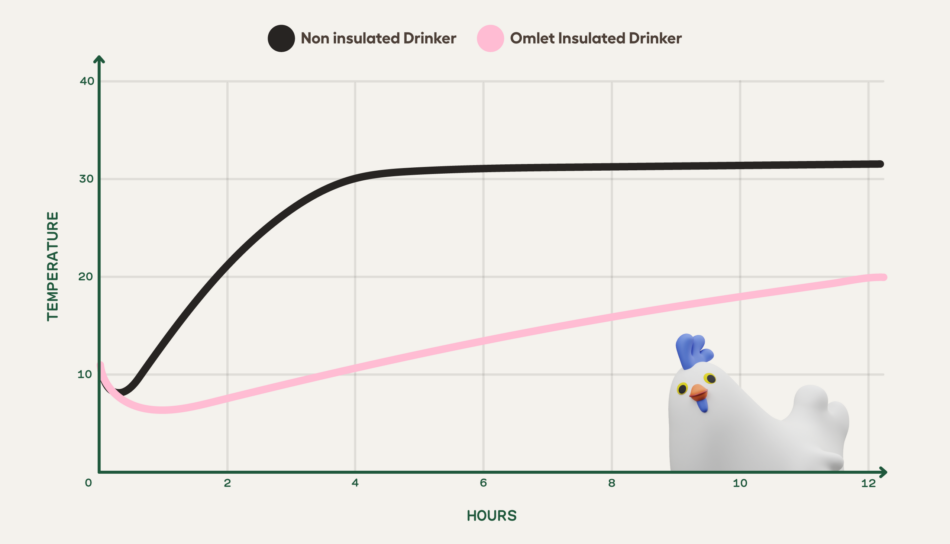
“The Insulated Drinker consistently performed four to five times better than comparable non-insulated drinkers.” Josh says seeing the results was one of the most rewarding parts of the project. “It was really interesting to see how much effect the insulation had on the water temperature.”
Why does water temperature matter?
Keeping water at a comfortable temperature isn’t just about convenience. It’s about encouraging chickens to drink. “Chickens are a bit fussy. As water moves outside their preferred temperature range, the amount they drink reduces.” On hot days especially, helping water stay cooler for longer can support better hydration and encourage chickens to keep drinking throughout the day.
Every feature has a purpose
Many of the final design features can be traced directly back to the challenges Rebecca’s team uncovered during research.
- To help reduce algae growth – the reservoir limits light exposure.
- To help keep water cleaner for longer – stored water is separated from the drinking area.
- To improve stability – the drinker features a tripod-style stand.
- And for greater flexibility – it can also be hung.
Every detail exists for a reason.
The listening never stops
Although the Insulated Drinker is now in chicken runs around the world, the process behind it is still ongoing. Customer feedback, reviews and real-world experiences continue to shape future improvements and innovations.
“We don’t just speak to people once at the beginning and then disappear into product development. We revisit them throughout the journey to test our thinking, uncover new insights and make sure the product is genuinely matching their needs.”
Because the best products aren’t designed for chicken keepers. They’re designed with them.
This entry was posted in Uncategorised